info@paramounttrek.com
+977-9856012294
Registration no: 398902/83/84
Tourism Licence No: 507

Experience the classic Annapurna Base Camp Trek through beautiful mountain landscapes, traditional villages, lush forests and breathtaking Himalayan scenery, ending at the spectacular Annapurna Base
Destination
Annapurna Region, Nepal
Accommodation
Teahouse
Walking Distance
65km
Duration
6 Night 7 Days
Max. Elevation
4,130 m (13,550 ft)
Meals Included
Breasfast, Lunch & Dinner
Best Season
Spring (Mar–May), Autumn (Sep–Nov)
Grade
Moderate
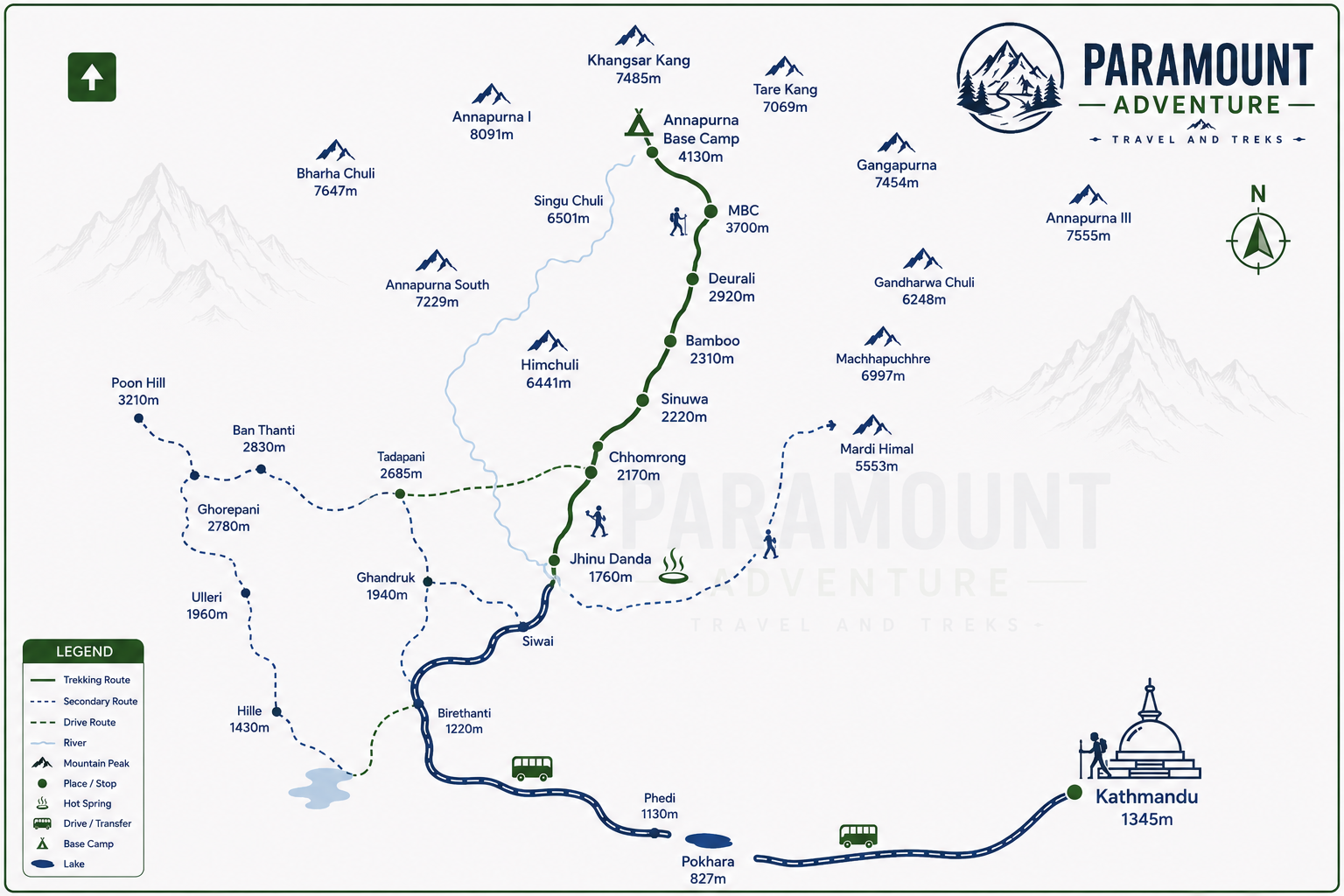
This trek reaches Annapurna Base Camp (4,130 m) in seven days from Pokhara, which makes it one of the shortest practical routes into the Annapurna Sanctuary, the glacial basin at the heart of the Annapurna Massif. A private jeep takes the group to Jhinu Danda, so the walking starts partway up the Modi Khola valley instead of on the lowland road.
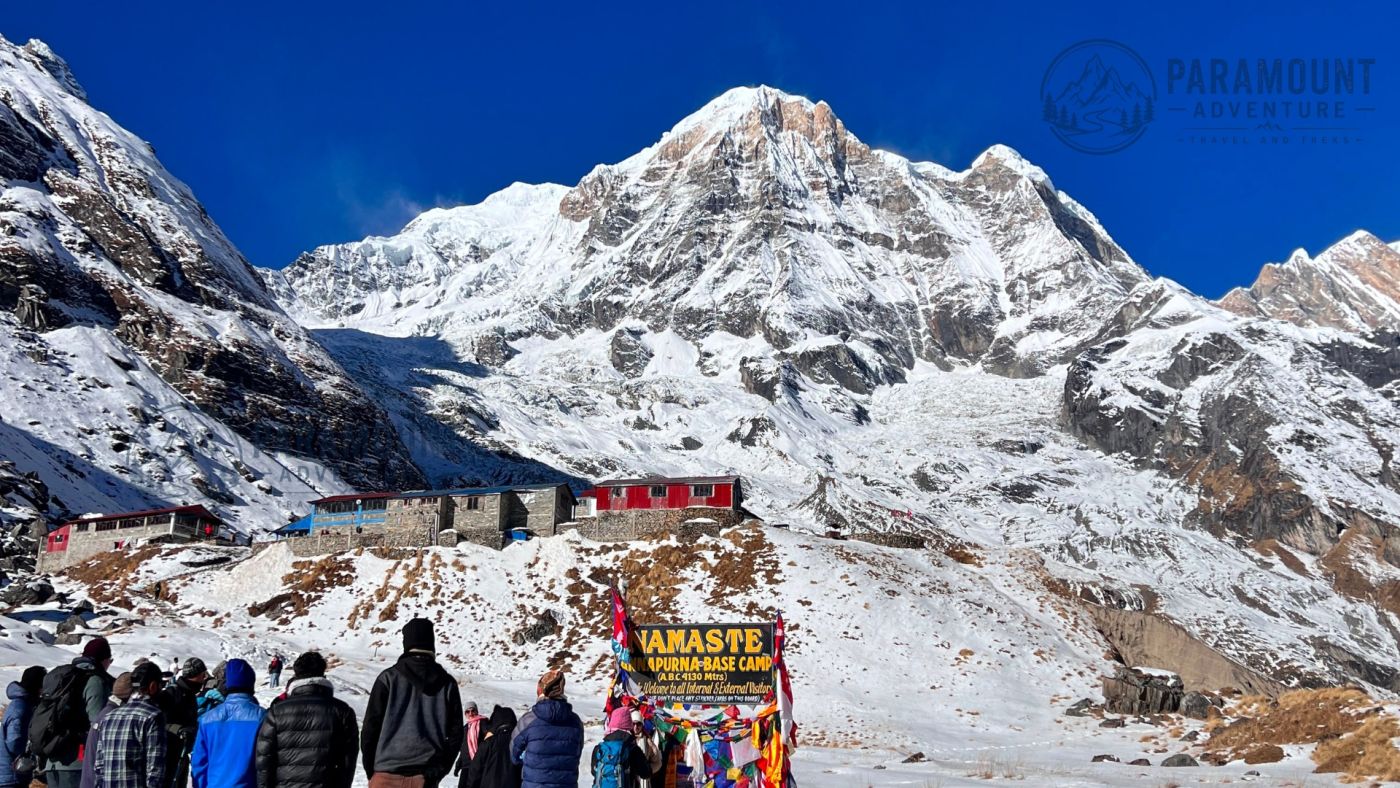
The whole route lies inside the Annapurna Conservation Area, managed by the National Trust for Nature Conservation. It climbs through Gurung villages, rhododendron and bamboo forest, and past Machhapuchhre Base Camp (3,700 m) before opening into a ring of peaks that includes Annapurna I (8,091 m). On the way down, a night at Jhinu Danda gives tired legs a soak in natural hot springs.
The Trekking Agencies’ Association of Nepal (TAAN) grades the trek as moderate. It suits fit beginners who can walk 5–6 hours a day, mostly on stone steps. Group prices run from USD 450 to 550 per person, and the best months are March–May and September–November. Travellers planning a first visit can find general travel information on the Nepal Tourism Board website.
Short on time? The short Annapurna Base Camp trek in 5 days and the 6-day Annapurna Base Camp trek reach the same base camp with a quicker ascent and fewer nights on the trail. They suit experienced, well-acclimatised walkers. This 7-day itinerary keeps a steadier climb and gives the body more time to adjust above 3,000 m, which is why it is the most popular choice for first-time trekkers.
Want a slower pace? The 10-day Annapurna Base Camp trek adds extra village time and gentler daily stages. Travellers who also want a sunrise viewpoint can combine the base camp route with the Ghorepani Poon Hill trek for a longer Sanctuary journey.
An easy warm-up is the Dhampus, Australian Camp and Pothana day hike. To compare every route, browse all Annapurna region treks. Read trip reviews, meet our team, or shape a private departure through Let’s Plan Together.
The Annapurna Base Camp Trek is possible in all seasons, but March to May (spring) and September to November (autumn) are usually the preferred periods. Since every season brings different weather and trail conditions, the right time to trek depends on what kind of experience and conditions you prefer.
Spring is a beautiful time to explore the Annapurna Base Camp route. The weather is generally pleasant and stable, with clearer skies, comfortable daytime temperatures and good visibility of the surrounding mountains. The lower and middle parts of the trail are also covered with blooming Rhododendron flowers.
There can still be some snowfall at higher elevations, creating a beautiful Himalayan backdrop. The generally favorable conditions make this season suitable for both beginners and experienced trekkers. A professional local guide is recommended to make the journey safer and more informative.
Autumn is considered one of the most favorable trekking seasons in Nepal, and the Annapurna Base Camp route is no different. After the monsoon, the skies and mountain surroundings are generally clear, offering excellent views of the Himalayan peaks.
The days are usually dry and comfortable, while temperatures become colder at higher elevations, especially during the night. This season also provides a chance to experience Nepalese traditions and celebrations, with festivals such as Dashain and Tihar commonly taking place during this period.
The monsoon season from June to August brings regular rainfall to the Annapurna region. Trails can become wet, muddy and slippery, while leeches may be present at lower elevations. Cloudy and rainy conditions can also reduce mountain visibility.
At the same time, monsoon gives the region a different character. The hills become lush and green, waterfalls are more active, and wildflowers add color to the landscape. The relatively quieter trails can appeal to experienced trekkers looking for a more peaceful trekking experience.
Winter brings much colder conditions and snowfall, especially across the higher sections of the Annapurna Base Camp route. From mid-December through February, heavier snowfall can sometimes make sections of the trail challenging and may affect access to higher areas.
Winter can be a rewarding option for trekkers who enjoy snowy landscapes and quieter trails, but it requires careful preparation. A qualified guide, proper winter clothing, suitable trekking equipment and travel insurance that includes emergency evacuation are strongly recommended.
If you are looking for a good balance of stable weather, clear mountain views and comfortable trekking conditions, spring and autumn are generally the best choices. Summer can suit trekkers who are comfortable with rain and prefer less crowded trails, while winter is more appropriate for experienced trekkers prepared for cold temperatures and possible snowfall.
Regardless of the season, the Annapurna Base Camp Trek combines mountain scenery, forests, traditional villages and local culture, making it a memorable trekking experience in Nepal.


Pokhara → Birethanti (permit check) → Jhinu Danda → Kimrong Khola bridge → Chhomrong
The morning begins with an early jeep ride out of Pokhara and into the Modi Khola valley, with the ACAP permit checked at Birethanti on the way. The road ends at Jhinu Danda, where the actual trek starts.
From here we cross the Kimrong Khola on a long suspension bridge, looking down at the river and the helipad on the far bank. Past the bridge, the trail turns into a stone staircase that climbs to Chhomrong in about three hours. It is the first real test for the legs, so we keep the pace slow.
Chhomrong, a large Gurung village, spreads across the hillside with lodges facing Annapurna South and Hiunchuli. We arrive with the afternoon still ahead, settle into the lodge and wander the village lanes and its gompa before dinner.
Chhomrong → Chhomrong Khola → Upper Sinuwa → Bamboo → Dovan
Breakfast in Chhomrong is followed by a short climb on stone steps to the ACAP recheck post, then about an hour of descent to the Chhomrong Khola suspension bridge.
On the far side, another staircase leads up to Upper Sinuwa. After it the trail eases into forest and passes small waterfalls, with Machhapuchhre (Fishtail) appearing between the trees before we stop for lunch at Bamboo.
The last two hours run through bamboo thickets, rocky slopes and rhododendron. The valley narrows and the air cools, an early sign of the altitude ahead.
Dovan is a small cluster of lodges inside the Modi Khola gorge. Dinner here is a good moment to try local Gurung-style dishes, and we go to bed early before the longest day of the climb.
Dovan → Himalaya → Hinku Cave → Deurali → Machhapuchhre Base Camp
The longest ascent day calls for a first-light start from Dovan. The trail passes the Pujinam Baraha Mandir, a small temple facing a waterfall that covers an entire cliff wall, and reaches the tea stop at Himalaya (2,920 m).
Beyond it the forest thins. We pass Hinku Cave, once a shepherds’ shelter, and cross the avalanche-prone stretch below Deurali (3,230 m), where the guide sets the timing and we do not linger.
Lunch at Deurali is followed by roughly two and a half hours up the valley, with rhododendron giving way to rock and patches of snow.
Machhapuchhre Base Camp sits directly beneath the Fishtail. We reach it in the afternoon and watch the light shift across the peaks. Because we sleep above 3,500 m tonight, any headache, nausea or poor sleep goes straight to the guide.
Machhapuchhre Base Camp → Annapurna Base Camp
Only 2.9 km separates the two base camps, so the walk is short, and the rocky trail is often covered in snow.
The valley then opens into a ring of summits: Annapurna I (8,091 m), Annapurna South (7,219 m), Gangapurna (7,455 m), Hiunchuli (6,441 m) and Machhapuchhre (6,993 m) all stand within view.
Memorials at the camp record the mountain’s history. One honours the French climber Maurice Herzog, whose team made the first ascent of Annapurna I in 1950, the first 8,000 m peak ever climbed. Another remembers the Korean mountaineer Park Young-seok, lost on Annapurna South in 2011.
We spend the rest of the day at Annapurna Base Camp for photographs and sunset. Temperatures fall fast after dark, so warm layers come out early.
Annapurna Base Camp → Machhapuchhre Base Camp → Deurali → Hinku Cave → Himalaya → Dovan
Sunrise comes first. Before breakfast we step outside as the first light reaches Annapurna I and turns the snow orange.
Then the descent begins, back through MBC, Deurali, Hinku Cave and Himalaya. The trail is mostly downhill, and with the altitude behind us the legs and lungs feel lighter than on the way up.
Below Himalaya the forest returns and the temperature rises. The waterfall at Pujinam Baraha Mandir looks different in afternoon light than it did on the climb.
We return to Dovan for hot food and an easy evening.
Dovan → Bamboo → Sinuwa → Chhomrong → Jhinu Danda
Day six is long on the clock, so we leave Dovan early. The trail drops to Bamboo, then climbs to Sinuwa, where lunch and a rest break are planned.
From Sinuwa the path rises again to Chhomrong, mostly uphill on stone steps. It is the last climb of the trek.
After Chhomrong, a long staircase descends to Jhinu Danda, a village known for its natural hot springs beside the river. A soak in the warm water is the reward for the week’s stairs.
We spend the evening in the village, with a relaxed dinner and no early alarm.
Jhinu Danda → Siwai → Birethanti (permit exit) → Pokhara (drive)
The final morning is unhurried. Anyone who wants another dip in the hot springs can start the day there before breakfast.
A 4.4 km walk leads to Siwai, about two hours along the valley, where the private jeep is waiting. Travellers who prefer to skip the walk can board the jeep directly at Jhinu Danda.
The drive to Pokhara takes about 2.5 hours, mostly on paved road with a few rough sections, and follows the Seti River for part of the way. Permits are checked one last time at Birethanti.
We reach Pokhara in the afternoon or early evening
|
Day |
Route |
Trek Distance |
Trek Hours |
Sleeping Altitude |
|
1 |
Pokhara → Jhinu Danda → Chhomrong |
~2 km |
~3 hrs (+ ~3 hrs drive) |
2,170 m |
|
2 |
Chhomrong → Dovan |
~8.6 km |
5–7 hrs |
2,520 m |
|
3 |
Dovan → MBC |
~13 km |
6–7 hrs |
3,700 m |
|
4 |
MBC → ABC |
~2.9 km |
2–3 hrs |
4,130 m |
|
5 |
ABC → Dovan |
~13 km |
~6 hrs |
2,520 m |
|
6 |
Dovan → Jhinu Danda |
~13 km |
6–7 hrs |
1,780 m |
|
7 |
Jhinu Danda → Siwai → Pokhara |
~4.4 km |
~2 hrs (+ ~2.5 hrs drive) |
820 m |
Change the duration, add experiences, choose your preferred accommodation, or create a completely private journey.
Let's Plan TogetherTransportation
Accommodation
Food & Meals
Guide & Porter
Permits & Fees
Medical / Safety Assistance
Equipment
Other Included Services
International Flights
Nepal Visa
Travel Insurance
Personal Expenses
Beverages
Hot Showers & Charging
Wi-Fi / Internet
Tips & Gratitude
Additional Expenses
| Group Size | Price / Person |
|---|---|
| 1+ persons | USD 550 |
| 2+ persons | USD 500 |
| 3 – 6 persons | USD 450 |
| 7 – 15 persons | USD 400 |
Trip Info & FAQs for Annapurna Base Camp Trek 7 Days from Pokhara
No reviews yet. Be the first to review this package!
Only customers with a completed booking for this package can submit a review. Your review will appear here once approved.
USD 550 per person
Tier: Default
👋
Select add-ons for specific participants.
Review your booking and select a payment method.
Who should the invoice/receipt be issued to?
A 10% deposit confirms your booking — we'll send bank transfer or payment link instructions by email right after you submit.