Registration no: 398902/83/84
Tourism Licence No: 507

The 10-Day Annapurna Base Camp Trek is one of the finest ways to experience the diverse landscapes, mountain scenery and cultural richness of the Annapurna region. Starting and ending in Pokhara.
Destination
Nepal
Accommodation
Teahouses/Lodges
Walking Distance
60–70 km
Duration
10 Days / 9 Nights
Max. Elevation
4,130 m / 13,550 ft
Meals Included
Breakfast, Lunch & Dinner during the trek
Best Season
Spring (Mar–May)
Grade
Moderate-Challenging
The 10-Day Annapurna Base Camp Trek is one of the finest ways to experience the diverse landscapes, mountain scenery and cultural richness of the Annapurna region. Starting and ending in Pokhara, this carefully paced journey takes you from the lush foothills of the Himalayas through traditional Gurung villages and rhododendron forests to the spectacular Annapurna Sanctuary at 4,130 meters.
The trek combines two of the region's most rewarding experiences: the panoramic sunrise from Poon Hill and the dramatic mountain setting of Annapurna Base Camp. As the trail climbs higher, the landscape gradually changes from terraced farmland and dense forests to alpine meadows, rugged mountain terrain and towering Himalayan peaks.
Along the way, you will pass through villages such as Ghorepani, Tadapani, Chhomrong, Bamboo and Deurali, experiencing the hospitality and traditions of local mountain communities. The trail also follows the Modi Khola valley into the Annapurna Sanctuary, where the mountains appear increasingly close and impressive.
At Annapurna Base Camp, the surrounding peaks create a spectacular natural amphitheater, with views of Annapurna I, Annapurna South, Hiunchuli, Machhapuchhre (Fishtail) and other Himalayan giants. The journey then descends through the forested valley toward Jhinu Danda before returning to Pokhara.
This itinerary offers a balanced combination of mountains, nature, culture and adventure, making it an excellent choice for travelers looking for a complete Annapurna Base Camp experience within 10 days.
Duration: 10 Days / 9 Nights
Starting Point: Pokhara
Ending Point: Pokhara
Maximum Elevation: 4,130 m / 13,550 ft
Approx. Trekking Distance: 60–70 km
Difficulty: Moderate to Challenging
Accommodation: Teahouses/Lodges
Meals: Breakfast, Lunch & Dinner during the trek
Best Seasons: March–May and September–November
Trek Type: Private / Group Trek
Best Time to Visit Annapurna Base Camp
The Annapurna Base Camp Trek can be enjoyed throughout the year, but spring (March–May) and autumn (September–November) are generally considered the most favorable seasons. Each season offers a different experience, so the ideal time ultimately depends on your weather preferences, trekking experience, and expectations.
Spring Season – March to May
Spring is one of the most beautiful periods for the Annapurna Base Camp Trek. The weather is generally stable, with clear skies, comfortable daytime temperatures, and excellent mountain visibility. The trails come alive with blooming Rhododendron flowers, particularly in the lower and middle sections of the route.
Occasional snowfall can still occur at higher elevations, adding to the Himalayan scenery. The pleasant conditions make spring suitable for both first-time and experienced trekkers. Hiring a professional local guide is recommended for a safer and more informative journey.
Autumn Season – September to November
Autumn is widely regarded as the best trekking season in Nepal, and Annapurna Base Camp is no exception. Following the monsoon, the atmosphere becomes fresh and clear, providing spectacular views of the surrounding Himalayan peaks.
Days are generally dry and pleasant, while nights become cooler as you gain elevation. Autumn also offers an opportunity to experience Nepalese culture, as major festivals such as Dashain and Tihar usually fall during this period.
Summer and Monsoon Season – June to August
The summer monsoon brings frequent rainfall to the Annapurna region, particularly from June through August. Wet and slippery trails, muddy sections, and leeches at lower elevations can make the trek more demanding. Mountain views may also be limited by clouds and rain.
However, the monsoon season has its own appeal. The landscape becomes exceptionally green, waterfalls are more active, and wildflowers add color to the hills. The quieter trails can also be attractive to experienced trekkers who prefer a more peaceful journey.
Winter Season – December to February
Winter brings cold temperatures and snowfall to the higher sections of the Annapurna Base Camp route. From mid-December to February, heavy snow can occasionally make some parts of the trail more difficult and affect access to higher elevations.
For trekkers seeking solitude and snowy Himalayan landscapes, winter can still be rewarding, but proper preparation is essential. A qualified guide, suitable winter clothing, travel insurance with emergency evacuation coverage, and appropriate trekking equipment are strongly recommended.
Which Season Is Best for Annapurna Base Camp?
For the best combination of stable weather, clear mountain views, and comfortable trekking conditions, spring and autumn are the top choices. Summer is ideal for those who don't mind rain and prefer quieter trails, while winter is better suited to experienced trekkers prepared for cold and possible snowfall.
No matter when you visit, the Annapurna Base Camp Trek offers an impressive combination of Himalayan landscapes, diverse forests, traditional villages, and rich local culture, making it one of Nepal's most rewarding trekking experiences.


Pokhara → Birethanti → Tikhedhunga → Ulleri
Our journey begins with an early drive from Pokhara through winding countryside roads to Birethanti, a lively riverside village where our trekking permits are checked and our walk officially starts.
From Birethanti, we follow the trail alongside the Bhurungdi Khola to Tikhedhunga, crossing a suspension bridge before the real climbing begins. The path then turns into a long, steep staircase of stone steps — one of the more demanding stretches of the entire trek, cut straight into the hillside.
By late afternoon, we reach Ulleri, a traditional Magar village perched on the ridge, its stone houses and terraced fields marking our first proper mountain overnight.
Ulleri → Banthanti → Nangethanti → Ghorepani
Leaving Ulleri's stone steps behind, we enter a completely different world — dense, quiet forest, thick with oak, magnolia, and rhododendron. The gradient eases here, and the walking settles into a steady, absorbing rhythm.
If we're trekking in spring, this stretch is where the rhododendron forest truly comes alive, with entire hillsides turning shades of red and pink. In autumn, the same trail offers a crisp, golden quiet instead.
We arrive in Ghorepani by early afternoon, a hilltop village with blue-roofed lodges and, on a clear day, our first real panorama across the Annapurna and Dhaulagiri ranges.
Ghorepani → Poon Hill → Ghorepani → Deurali → Tadapani
Well before sunrise, we climb by headlamp to Poon Hill, one of the most celebrated viewpoints in the Annapurna region. As the sky lightens, the Annapurna and Dhaulagiri ranges catch the first light in sequence — a slow, golden unveiling of some of the highest peaks on Earth.
After returning to Ghorepani for breakfast, we set off through forested ridgeline trail toward Tadapani, the terrain undulating gently through more rhododendron woodland, with peaks occasionally breaking through the canopy.
We reach Tadapani by late afternoon, a small forest-fringed settlement that feels notably quieter than the more-visited Ghorepani.
Tadapani → Chuile → Kimrong Khola → Chhomrong
We descend from Tadapani through cool, shaded forest, dropping steadily toward the Kimrong Khola, which we cross by suspension bridge at the valley floor. The change in scenery is immediate — thicker greenery, warmer air, and the first real sense of entering a deeper valley system.
From the river, a long, steady climb carries us up toward Chhomrong, one of the most significant villages on the entire Annapurna Base Camp route and the traditional gateway to the Annapurna Sanctuary.
Chhomrong sits dramatically on the hillside, overlooking the Modi Khola valley, with clear views of Annapurna South and Hiunchuli rising directly ahead.
Chhomrong → Chhomrong Khola → Sinuwa → Bamboo
We begin with a steep descent down Chhomrong's famous stone staircase, crossing the Chhomrong Khola before climbing again toward Sinuwa, perched on the opposite ridge.
Beyond Sinuwa, the trail levels into a long, atmospheric walk through increasingly dense forest, the vegetation growing greener and thicker with every kilometer as we move deeper into the valley.
By afternoon, we reach Bamboo, a small cluster of teahouses named for the dense bamboo groves surrounding it — a quiet, shaded stop beside the Modi Khola.
Bamboo → Dovan → Himalaya → Deurali
Today we move deeper into the Annapurna Sanctuary, following the Modi Khola through dense bamboo and rhododendron forest toward Dovan, the trail narrowing as steep valley walls close in on both sides.
Beyond Dovan, we reach Himalaya, where the forest visibly begins to thin. From here, the landscape shifts quickly — trees give way to open, rocky terrain, and the alpine character of the high Annapurna region starts to take over.
The final stretch to Deurali climbs steadily through this thinning, high-altitude terrain, delivering our first real sense of the scale of the mountains now surrounding us.
Deurali → Machhapuchhre Base Camp → Annapurna Base Camp
This is the day the entire trek has been building toward. We follow the Modi Khola valley upward from Deurali, the terrain increasingly rugged and open, with towering peaks now visible on nearly every side.
We pass through Machhapuchhre Base Camp, sitting almost directly beneath the sacred, unclimbed summit of Fishtail Mountain, before continuing the final approach into the heart of the Annapurna Sanctuary.
Arriving at Annapurna Base Camp (4,130 m), we find ourselves inside a natural amphitheater of some of the world's highest peaks — Annapurna I, Annapurna South, Gangapurna, and Hiunchuli all rising around us. As evening settles in, the fading light on the surrounding summits makes for one of the most memorable moments of the entire journey.
Annapurna Base Camp → Machhapuchhre Base Camp → Deurali → Dovan → Bamboo
We wake early to take in a final sunrise over the Annapurna massif, the surrounding peaks glowing gold before we begin our long descent.
The return route retraces our path through Machhapuchhre Base Camp, Deurali, and Dovan, and while breathing feels noticeably easier at each step down, the sheer distance makes today one of the longest of the trip.
By the time we reach Bamboo, our legs — particularly our knees — have done the harder work today, even if our lungs are thanking us for the lower altitude.
Bamboo → Sinuwa → Chhomrong → Jhinu Danda → Pokhara (drive)
We continue our descent through forest trail back toward Sinuwa and up to Chhomrong, retracing familiar ground one final time before dropping off the ridge toward Jhinu Danda.
Jhinu is best known for its natural hot springs beside the Modi Khola, and depending on our timing and energy, we take the chance to soak tired legs in the warm mineral pools before continuing onward.
From Jhinu Danda, our private vehicle meets us for the drive back to Pokhara. After checking into our hotel, the evening is ours to unwind beside Phewa Lake, celebrating the completion of the trek with the whole team.
Our final morning is a relaxed one. After breakfast at the hotel, the trek officially comes to a close, with the rest of the day free for onward travel arrangements.
If time allows before departure, Pokhara itself is worth lingering in — Phewa Lake, the World Peace Pagoda, Davis Falls, and the International Mountain Museum are all easily explored at a relaxed pace before saying goodbye to the Annapurna region.
|
Day |
Route |
Distance |
Walking Time |
Altitude |
|
Day 1 |
Pokhara → Birethanti → Ulleri |
10–12 km |
4–5 hrs |
1,960 m |
|
Day 2 |
Ulleri → Ghorepani |
8–9 km |
4–5 hrs |
2,860 m |
|
Day 3 |
Ghorepani → Poon Hill → Tadapani |
10–11 km |
5–6 hrs |
3,210 m* |
|
Day 4 |
Tadapani → Chhomrong |
9–10 km |
5–6 hrs |
2,170 m |
|
Day 5 |
Chhomrong → Sinuwa → Bamboo |
8–9 km |
5–6 hrs |
2,310 m |
|
Day 6 |
Bamboo → Dovan → Himalaya → Deurali |
9–10 km |
5–6 hrs |
3,230 m |
|
Day 7 |
Deurali → MBC → Annapurna Base Camp |
8–9 km |
5–6 hrs |
4,130 m |
|
Day 8 |
Annapurna Base Camp → MBC → Deurali → Bamboo |
16–17 km |
7–8 hrs |
2,310 m |
|
Day 9 |
Bamboo → Sinuwa → Chhomrong → Jhinu Danda |
10–12 km |
5–6 hrs |
1,780 m |
|
Day 10 |
Pokhara |
— |
— |
822 m |
Let's customize this itinerary as per your time and budget, as you like.
Transportation
Accommodation
Food & Meals
Guide & Porter
Permits & Fees
Medical / Safety Assistance
Equipment
Other Included Services
Transportation
Accommodation
Food & Meals
Guide & Porter
Permits & Fees
Medical / Safety Assistance
Equipment
Other Included Services
International Flights
Nepal Visa
Travel Insurance
Personal Expenses
Beverages
Hot Showers & Charging
Wi-Fi / Internet
Tips & Gratitude
Additional Expenses
International Flights
Accommodation not Included
Meals not Included
Supporter / Porter
Travel Insurance
Tips
Other Exclusions
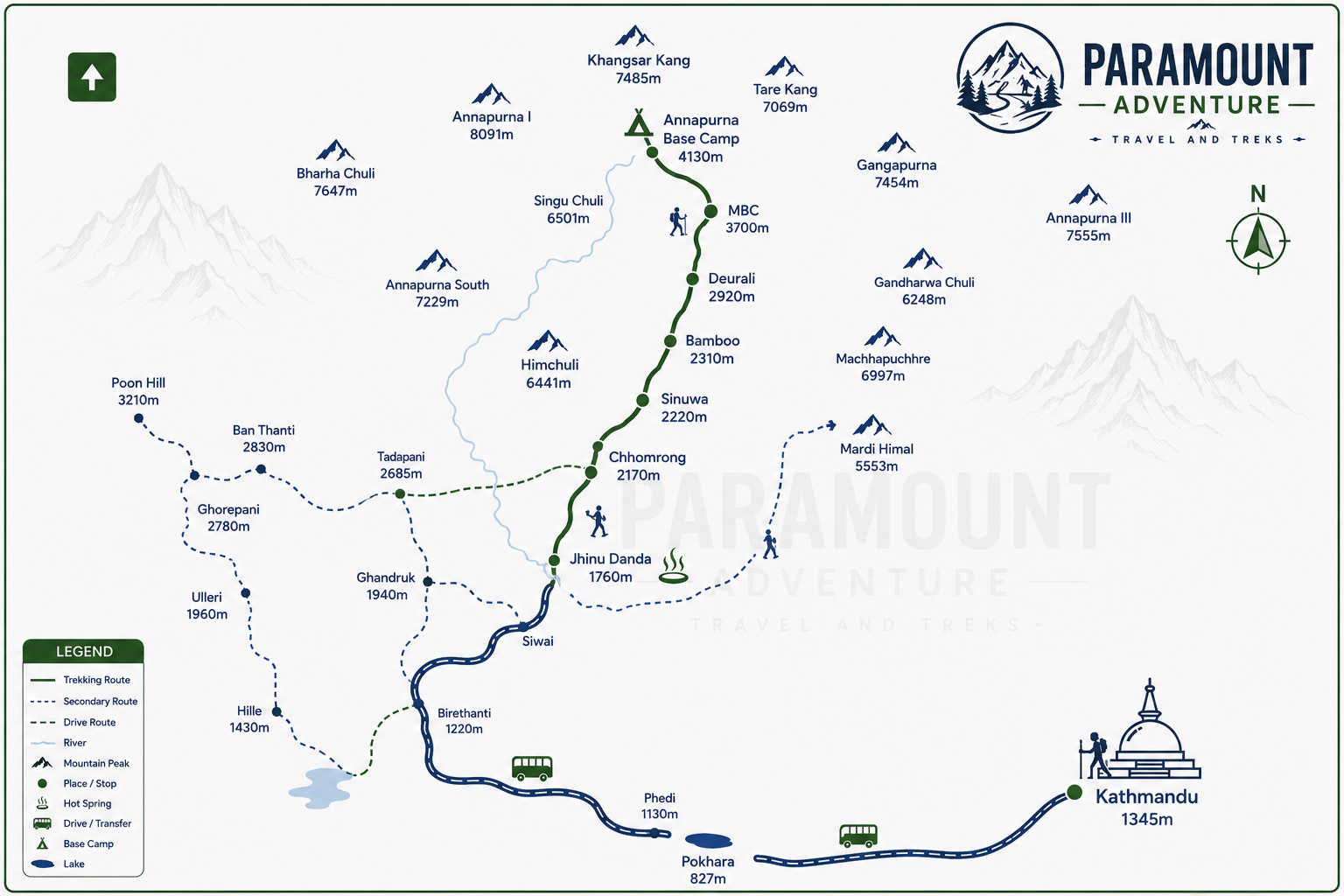
Trekking Route
| Group Size | Price / Person |
|---|---|
| 1 person | USD 850 |
| 2 persons | USD 700 |
| 3 – 5 persons | USD 650 |
| 6 – 10 persons | USD 600 |
| 11+ persons | USD 550 |
Includes a licensed guide, required permits, tea house lodging, transportation, along with all daily meals (breakfast, lunch, dinner) and tea or coffee.
Covers your guide, permits, tea house lodging, morning tea, and transportation. Lunch and dinner are purchased out-of-pocket on the trail, giving you control over meal choices.
| Licensed English-Speaking Guide | Includes the guide's insurance and daily expenses. | $28 / per day |
| Porter | Porter service for carrying trekking luggage. | $22 / per day |
| ACAP Entry Permit | Annapurna Conservation Area entry permit. | $25 / per day |
| Daily Meals (Trailside) | Approximately $30 per day, based on an average of $10 per meal. | $30 / per day |
Trip Info & FAQs for 10 Days Annapurna Basecamp Trek
No reviews yet. Be the first to review this package!
Only customers with a completed booking for this package can submit a review. Your review will appear here once approved.
USD 850 per person
Tier: Default
👋
Select add-ons for specific participants.
Review your booking and select a payment method.
Who should the invoice/receipt be issued to?
A 10% deposit confirms your booking — we'll send bank transfer or payment link instructions by email right after you submit.


